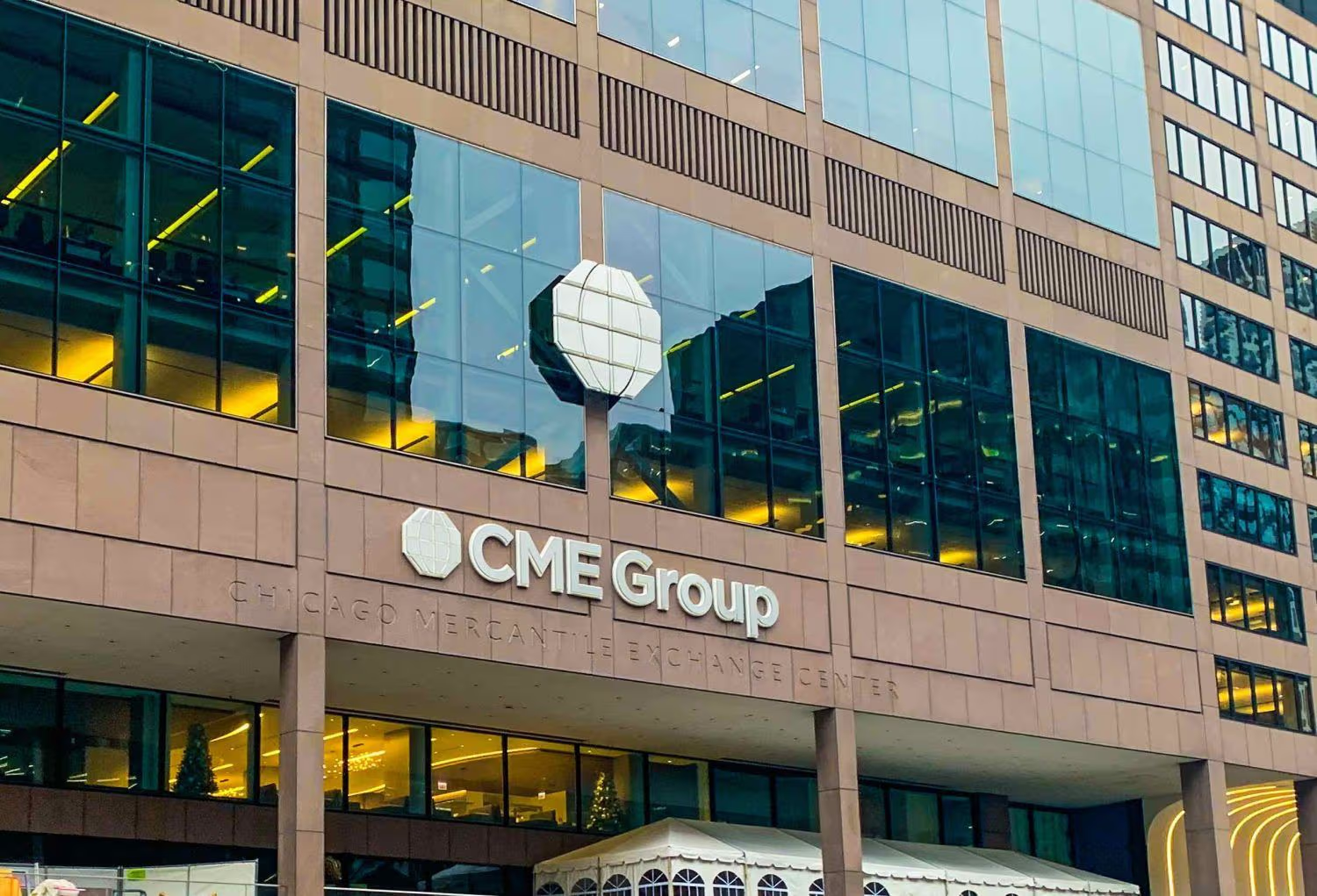
A major outage at CME Group, the world’s largest derivatives exchange operator, left brokers facing severe operational challenges on Friday as core futures markets went dark for several hours.
The disruption began after a cooling-system failure at CyrusOne’s CHI1 data centre in the Chicago area, taking down Globex — the electronic backbone of CME’s global futures trading infrastructure.
The malfunction forced firms to find emergency solutions as official market pricing froze across several major asset classes.
Cooling Failure Halts a Central Component of Global Trading
CyrusOne said its engineering teams were able to restart some of the cooling systems at reduced capacity while deploying temporary equipment, but it did not provide a timeline for full restoration.
The outage lasted longer than a similar incident in 2019 and highlighted the systemic importance of CME’s data pipelines.
Several core futures contracts — covering energy, metals, equity indexes and Treasuries — stopped updating, leaving traders without live benchmark prices for products including WTI crude, gold, Nikkei futures and U.S. 10-year notes.
Partial Operations Return, but Stress Rippled Through Markets
While CME later restored connectivity for certain services, including BrokerTec EU, BrokerTec US Actives and EBS, the broader freeze acted as a real-time stress test for brokers.
Gold spreads widened sharply during the outage, and liquidity in cash Treasuries thinned significantly as traders moved to alternative venues that lacked CME’s depth.
With official pricing unavailable, many brokers faced a choice between halting services or exposing themselves to significant market-making risk.
Brokers Forced to Rely on Internal Pricing
CMC Markets, which continued quoting for clients throughout the disruption, said it had to resort to internal models and proprietary data when CME benchmarks became unavailable.
“We’re now taking a lot of unnecessary risk here to continue pricing,” Christopher Forbes, head of Asia and the Middle East at CMC, told Reuters.
He said he had not seen a situation like this in 20 years.
Other brokers including Saxo Bank, XTB and eToro opted to halt trading temporarily on U.S. index, commodity and Treasury futures, preventing clients from taking positions without reliable price feeds.
Options Expiry Escalates Risk
The outage landed on a day when roughly $600 billion in S&P 500-linked options were set to expire, adding further pressure to dealers managing hedges.
Some firms shifted exposure into ETFs or Euro Stoxx futures as workarounds, though neither instrument provides a perfect correlation with SPX futures.
Despite the disruption, holiday-period trading volumes were thin, reducing the risk of broader instability.
“If it has to happen, then today is probably the best day for it,” Michael Brown of Pepperstone told Reuters.
Outage Highlights Hidden Market Vulnerabilities
Although systems began coming back online, the episode raised fresh concerns about the fragility of global derivatives infrastructure.
The outage showed that when a benchmark source suddenly disappears, risk is not eliminated — it is pushed down onto brokers who must decide whether to operate blindly or shut down services.
The incident is expected to renew calls for stronger redundancy systems at critical trading hubs.