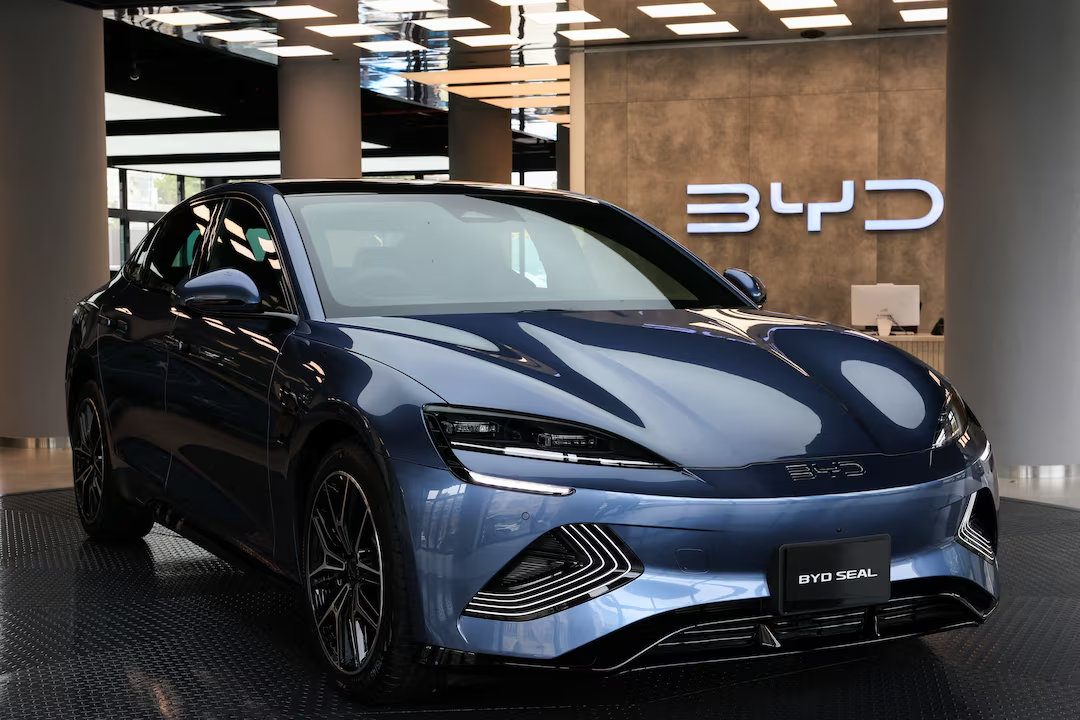
China’s electric vehicle market is becoming increasingly competitive as rival automakers steadily close the gap with industry leader BYD during the first months of 2026.
Combined sales for January and February showed that several domestic competitors recorded substantial year-on-year growth, even as overall demand across the Chinese EV market experienced signs of slowing momentum.
BYD’s own sales performance declined significantly compared with the previous year, with deliveries falling roughly 36% during the two-month period once seasonal factors such as the Lunar New Year holiday were considered.
The decline does not necessarily signal a collapse in demand for BYD vehicles, but it reflects a rapidly evolving competitive landscape where rival manufacturers are gaining traction across key consumer segments.
Competitors Post Strong Growth In Early 2026
Several emerging EV brands delivered impressive sales increases during the same period, highlighting the accelerating pace of competition within the world’s largest electric vehicle market.
Leapmotor reported combined sales of 60,126 vehicles during January and February, representing a year-on-year increase of approximately 19% compared with the same months in the previous year.
Technology giant Xiaomi also demonstrated rapid growth in the sector, selling more than 59,000 vehicles across the two months and recording a significant 48% jump in annual sales performance.
Meanwhile, Nio and Geely’s Zeekr brand reported particularly strong expansion, with their combined deliveries rising roughly 77% and 84% respectively over the same period.
Market Dynamics Shift Toward Greater Competition
Analysts say the narrowing gap between BYD and its competitors reflects a broader shift within China’s electric vehicle industry as new models increasingly rival BYD’s offerings in both price and technology.
“BYD’s lead is real but narrowing… A full reversal is unlikely near-term, but domestic share compression is the direction of travel,” said Leon Cheng, head of the mobility practice at consulting firm YCP.
In recent years BYD has commanded between 26% and 34% of China’s new energy vehicle market, though competitors have begun challenging the company in segments traditionally dominated by its models.
Manufacturers have increasingly adopted aggressive product strategies designed to maximize value for consumers while maintaining competitive pricing across the rapidly expanding EV market.
Consumer Trends And Policy Changes Affect Demand
China’s EV sector is also experiencing shifting consumer behavior following the reintroduction of a purchase tax on new energy vehicles that had previously been partially waived by regulators.
Beginning in 2026, buyers must pay a 5% purchase tax on EVs rather than receiving full exemptions, increasing the overall cost of purchasing electric vehicles for many consumers.
The policy change may have created a temporary demand gap after buyers rushed to complete purchases before the tax was reinstated at the end of 2025.
“The 5% tax, for instance, on a car priced at $200,000… is still like $10,000 [added] to the purchase cost, so… it’s something to think about,” said Abby Tu, principal research analyst at S&P Global Mobility.
BYD Expands Overseas As Domestic Pressure Builds
While competition intensifies domestically, BYD has increasingly turned toward global markets to sustain growth and offset pressure within China’s rapidly evolving EV sector.
Exports surpassed domestic sales for the first time in February, reflecting the company’s expanding international footprint as it enters markets across Europe, Southeast Asia and Latin America.
“BYD’s hedge is exports — [the company’s] overseas sales crossed 1 million units in 2025 for the first time, a buffer purely domestic rivals can’t match,” Cheng explained.
Analysts also expect the company to launch new technologies later this year, including an updated Blade Battery system and faster charging solutions designed to reinforce its competitive position.