Asian stocks closed mostly higher on Monday as investors weighed ongoing geopolitical negotiations and awaited critical US economic data due later in the week.
Profit-taking in semiconductor and artificial intelligence-related stocks tempered broader gains, with traders worried about the prospect of higher interest rates by year’s end.
The US dollar was on track for its best monthly performance in nearly a year ahead of the closely watched nonfarm payrolls report.
The annual central banker gathering at Sintra, Portugal, also loomed large as a key event for markets this week, adding further uncertainty to rate expectations.
Gold edged lower to hover around $4,060 an ounce amid renewed uncertainty over the fragile ceasefire between the US and Iran.
Brent crude futures held above $72 a barrel in Asian trading, recovering modestly from four-month lows hit last week after the US and Iran agreed to meet Tuesday in Qatar’s capital to resolve their dispute over the Strait of Hormuz.
China’s Shanghai Composite index rallied 1.16 percent to 4,073.90, led by gains in consumer and healthcare shares, while Hong Kong’s Hang Seng index jumped 1.57 percent to 23,026.68.
The Hang Seng advance came after reports suggested that Apple (AAPL) is lobbying the US government for approval to purchase DRAM chips from Chinese memory manufacturer CXMT.
Japanese markets reversed early losses to finish slightly higher, supported by data showing Japanese consumers spent well ahead of forecasts in May, giving sentiment a modest boost.
The Nikkei average closed 0.15 percent higher at 69,468.11 after South Korea announced a $576 billion semiconductor and AI investment plan, backed by Samsung and SK Hynix, to strengthen its global chip leadership.
SoftBank Group shares plunged 5.3 percent on news of a potential delay in OpenAI’s IPO, while Kioxia Holdings lost over 4 percent and Advantest fell 1.5 percent.
Tokyo Electron bucked the trend among chip stocks, advancing 2.4 percent as investors selectively repositioned within the sector.
Seoul’s Kospi index closed 0.20 percent lower at 8,394.65 after hitting as low as 8,127.99 earlier in the session, dragged down by losses in the technology sector.
Samsung Electronics (KRX: 005930) slumped 4.8 percent and SK Hynix dropped 1.7 percent after the Financial Supervisory Service indefinitely postponed the launch of weekly options for blue-chip stocks, citing extreme volatility.
Battery stocks surged strongly, with LG Energy Solution climbing 20.8 percent and Samsung SDI gaining 12.5 percent, providing some offset to the tech-driven weakness.
Australian markets posted notable gains, with the benchmark S&P/ASX 200 rising 0.68 percent to close at 8,823.40, driven by advances in banking, technology, and resource stocks.
New Zealand’s benchmark S&P/NZX-50 index rose 0.37 percent to 13,545.56, reversing early losses to finish in positive territory.
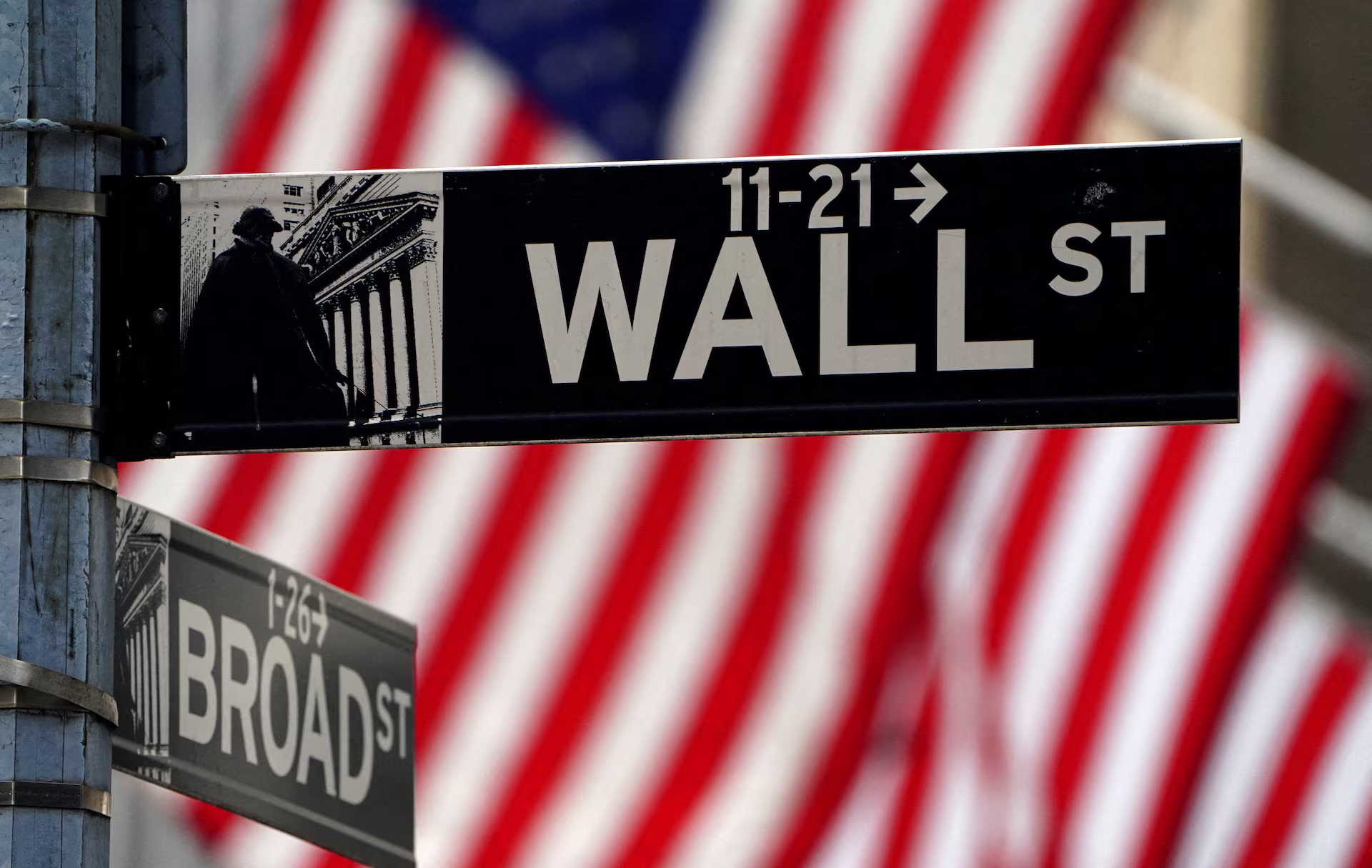
On Wall Street Friday, US stocks ended off their day’s lows as lower oil prices stemming from improved shipping traffic through the Strait of Hormuz helped offset AI spending concerns and rising memory and storage costs.
Investor sentiment was also weighed down by reports suggesting that OpenAI, the maker of ChatGPT, was leaning toward holding off its highly anticipated IPO until next year.
The Dow and the S&P 500 both finished marginally lower, while the tech-heavy Nasdaq Composite slipped 0.2 percent amid shifting expectations around US monetary policy.