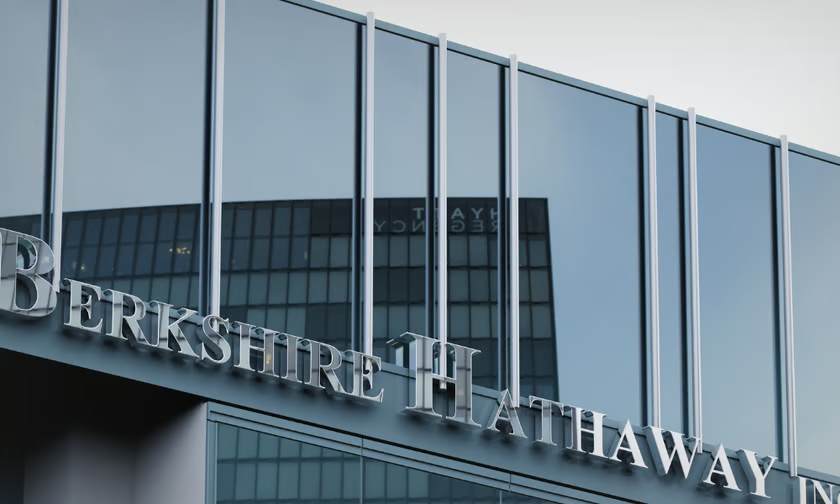
Warren Buffett has officially stepped down as Executive Chairman of Berkshire Hathaway (NYSE: BRKA)(NYSE: BRKB), effective immediately, marking another significant transition for the legendary conglomerate.
Buffett had already handed the CEO role to Greg Abel at the end of last year, but he continued to play a major part in the company’s investment decisions through his chairman position.
He now holds the title of chairman emeritus, with his son Howard Buffett stepping into the chairman role as part of a long-planned succession strategy.
Howard Buffett’s role is not an operational one, and he will not be involved in the day-to-day running of the business at any level.
The sole purpose of Howard assuming the chairmanship is to protect and preserve the culture Warren Buffett spent six decades carefully building at Berkshire.
For many investors, the news may feel like the definitive close of a historic chapter, but the underlying investment thesis for Berkshire remains largely intact.
Much of the so-called “Buffett premium” was already stripped from the stock back at the May 2025 shareholder meeting, when Buffett announced his retirement from the CEO role.
The stock hit its all-time high just before that meeting and has remained below that level ever since, meaning the market had already digested much of the transition risk.
Berkshire’s share price barely moved on the most recent news, which reflects that at age 96, Buffett’s departure from active duties was something the market had largely priced in.
CEO Greg Abel has been performing strongly in his capital allocation responsibilities, ending 14 consecutive quarters of net equity selling in the second quarter of this year.
Abel also spent more on buybacks than Berkshire has in five years, and completed a substantial acquisition of a beaten-down homebuilder, signaling an active and disciplined deployment of capital.
The lack of capital deployment had been shareholders’ biggest criticism during the final years of Buffett’s active tenure, and Abel appears to be addressing that concern directly.
When investors buy Berkshire stock today, they are buying into a collection of dozens of businesses, a massive equity portfolio full of high-quality companies, and unmatched financial flexibility.
No publicly traded company in the world currently holds more financial flexibility than Berkshire Hathaway, a structural advantage that does not disappear with any leadership change.
Buffett spent decades constructing a durable institution with the right culture, the right processes, and the right leaders to carry the company into its next 50 years.