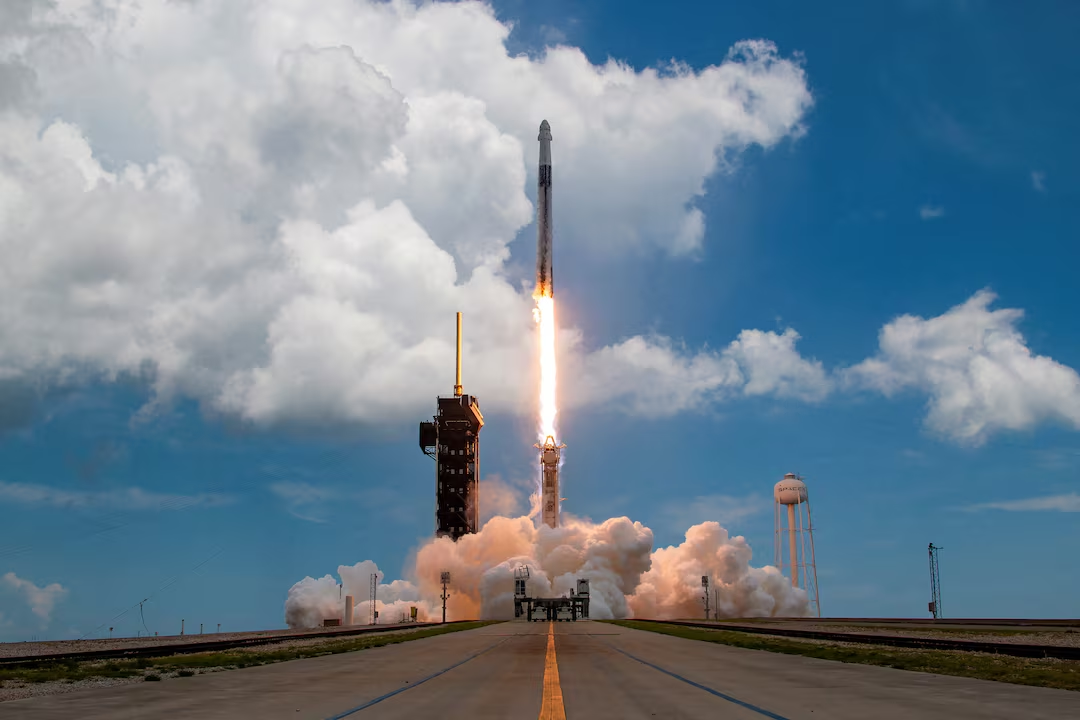
Over the last few months, Amazon’s satellite internet provider Leo has been launching internet satellites to become the next Western competitor to Starlink. Imposed with a July 2026 deadline, Amazon is seeking an extension from the FCC to get the project off the ground. SpaceX has taken the opportunity to challenge its competition.
How Satellite Internet Works
For many years, Starlink has been the only company operating a low-Earth orbit (LEO) constellation for satellite internet. Using over 9,000 satellites, with plans for more than 30,000, Starlink allows paying subscribers to beam an internet connection down from space.
This novel form of internet delivery bypasses infrastructure concerns, making online services accessible for those in rural or deprived areas. Its benefits are cultural as well as economic; it enables remote working but also provides more avenues for consumers to pursue new digital entertainment. Internet-driven media, like streaming services or websites offering interactive content, will only grow in the future.
This means more sites like SkyCity Casino that offer slots and live lounges to users, played using a social currency that only exists in the digital space. As that space grows, users will expect variety in service providers and reliable connections that don’t depend on local infrastructure.
Until recently, SpaceX’s Starlink was the only provider offering a workable, expansive LEO internet delivery system. While China launched its own Thousand Sails constellation, Amazon entered the fray with its own plans to launch and compete with SpaceX as a Western service provider.
Amazon Leo’s Launch Race
Before they could launch, Amazon Leo had to get approval from the Federal Communications Commission (FCC). They succeeded at this way back in 2020 with authorisation to send 3,236 satellites into space, but the FCC gave them one condition. Amazon needed to launch 50% of those satellites (1,618) before the end of July 2026.
Leo, formerly Project Kuiper, didn’t start launching until late 2025, with some 200 satellites in the air as of February 2026. Though the FCC has expanded Amazon’s proposed constellation by authorising up to 7,736 satellites now, the whole project is still beholden to that original July 2026 deadline. About Amazon details how the tech giant is expanding its rocket fleet to increase satellite payloads.
SpaceX’s Intervention
Nevertheless, Amazon filed to push the deadline back to July 2028 instead, having projected that they’ll only have 700 satellites in orbit by this July. Amazon argues that it suffered unforeseeable retooling after 2023 launch tests, and that it has the satellites, but the private aerospace industry is suffering from a rocket shortage.
This prompted SpaceX to file in opposition to the request, arguing that no such shortage exists. For many of its early Kuiper test launches, and now Leo production launches, Amazon relied on SpaceX’s own Falcon rocketry. Instead of being hard competitors, SpaceX was willing to sell rockets to enable Amazon’s competitive enterprise. So, SpaceX argues, they could have kept buying SpaceX rockets instead of spending time pursuing other providers like Jeff Bezos’ own Blue Origin.
It’s a shot across the bow between competitors who had seemed amicable thus far. The FCC is yet to rule on the extension, having opened up a comment period where other aeronautics and communications companies can signal concerns. There’s no doubt that the FCC’s recent decision to allow Amazon to launch more satellites, plus fears of a Starlink monopoly, will play a role in the final judgment.