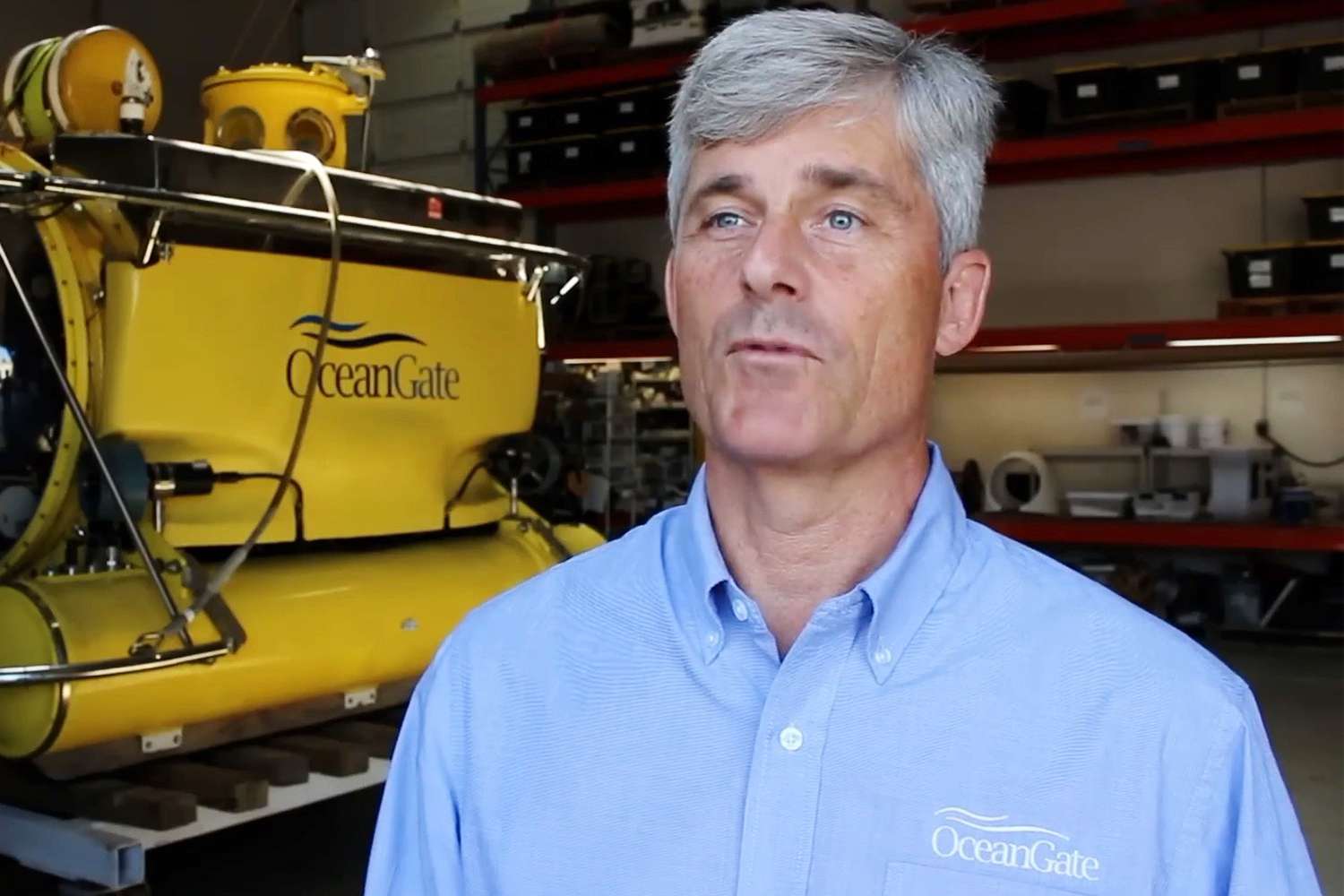
At the time of his death, Stockton Rush’s estimated net worth ranged between $12 million and $25 million.
Born on March 31, 1962, in San Francisco, California, Richard Stockton Rush III grew up surrounded by an extraordinary legacy of American history and industrial achievement.
His family background was remarkable, with paternal ancestors including two signers of the Declaration of Independence, Dr. Benjamin Rush and Richard Stockton.
His maternal grandfather, Ralph K. Davies, was a prominent industrialist and the namesake of San Francisco’s Davies Symphony Hall, adding cultural significance to his lineage.
Rush attended the prestigious Phillips Exeter Academy before earning a Bachelor of Science in Aerospace Engineering from Princeton University in 1984.
He furthered his education with an MBA from the University of California, Berkeley, in 1989, equipping himself with both technical and business expertise.
His early career saw him working as a flight-test engineer for McDonnell Douglas on the F-15 Eagle jet program, where his passion for aviation burned intensely.
Rush became the youngest person to obtain a jet transport pilot’s license at just 19 years old, also building his own experimental aircraft at that age.
His ambitions to become an astronaut were ultimately grounded by vision issues that disqualified him from military service, redirecting his focus toward other frontiers.
He transitioned into venture capital at Peregrine Partners in San Francisco during the late 1980s before relocating to the Pacific Northwest to run Remote Control Technology in Kirkland, Washington.
In 2009, Rush founded OceanGate, a company dedicated to developing manned submersibles for deep-sea exploration, which became the defining chapter of his career.
As CEO of OceanGate, he led the development of the Titan submersible, which was designed to carry passengers to the Titanic wreck site using unconventional carbon fiber and titanium construction.
Despite warnings from industry experts about the suitability of these materials under extreme deep-sea pressure, Rush remained committed to his vision for the vessel.
OceanGate conducted multiple expeditions under his leadership, but the company also faced legal challenges, including a lawsuit filed by a Florida couple alleging fraud over a canceled Titanic expedition.
In his personal life, Rush married Wendy Weil in 1986, a descendant of Isidor and Ida Straus, who famously perished in the original Titanic disaster of 1912.
Wendy Rush served as Director of Communications at OceanGate and was aboard the support vessel Polar Prince during the fatal dive on June 18, 2023.
On that day, the Titan submersible lost communication during its descent to the Titanic wreck site, carrying Rush and four other individuals.
The submersible was subsequently found to have suffered a catastrophic implosion, killing all five people aboard and sending shockwaves around the world.
Following the disaster, documentaries including BBC’s “Implosion: The Titanic Sub Disaster” and Netflix’s “Titan: The OceanGate Disaster” investigated the circumstances and safety culture at OceanGate.
At the time of his death, Rush’s estimated net worth ranged between $12 million and $25 million, derived from his aerospace and deep-sea exploration ventures.
Rush also established the OceanGate Foundation in 2012, a philanthropic initiative aimed at promoting ocean exploration and education for future generations.
His life and death have since ignited broader conversations about safety standards, ethical responsibilities, and regulatory oversight in the field of deep-sea exploration.