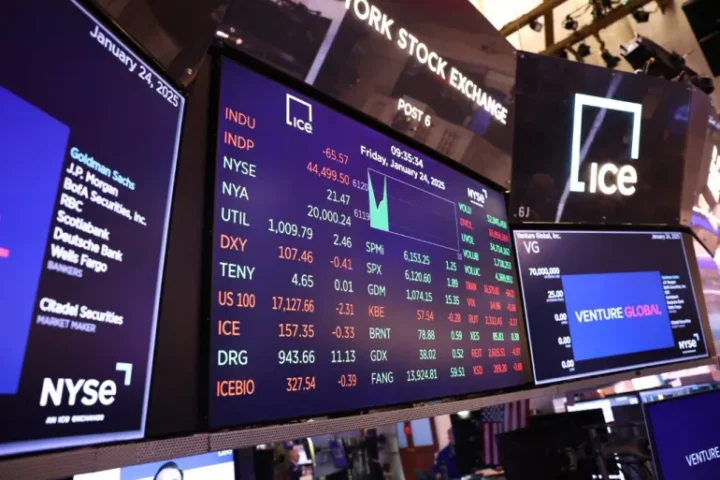
Asian stocks fell sharply on Friday, extending a global selloff after Wall Street posted its fourth consecutive session of losses.
Inflation and interest rate concerns intensified after Brent crude prices jumped to their highest level since May, driven by escalating Middle East tensions.
U.S. producer price inflation also came in stronger than expected, pushing the probability of a Federal Reserve rate hike next week to 72 percent.
European Central Bank President Christine Lagarde added to the cautious mood Thursday, warning that “the outlook remains highly uncertain, with risks tilted upward for inflation and downward for growth,” after raising three key rates by 25 basis points.
Markets are now closely watching the U.S. consumer price index reading for August, with economists projecting headline inflation at 0.4 percent month-on-month and 3.4 percent year-on-year.
That CPI data will serve as a critical input for the Federal Reserve’s September 16 interest-rate decision, adding pressure to already nervous global markets.
The U.S. dollar held gains in Asian trade while gold climbed to $4,353 an ounce, recovering after hitting a one-week low earlier in the session.
Brent crude futures fell more than 2 percent toward $105 a barrel after the Financial Times reported that Iran and Oman were meeting with Gulf states to reopen shipping through the Strait of Hormuz.
Gulf foreign ministers are planning to meet their Iranian counterpart in the Omani coastal city of Salalah this coming Monday to secure a deal managing commercial shipping through the strait.
China’s Shanghai Composite index fell 1.18 percent to 3,888.11, while Hong Kong’s Hang Seng index dropped 0.60 percent to 24,805.63 on expectations of further U.S. interest-rate hikes.
Japanese markets tumbled on concerns over surging oil prices and rising U.S. Treasury yields, with the Nikkei average slumping 1.93 percent to 64,011.34.
The broader Topix index closed 0.65 percent lower at 4,028.30, as Kioxia lost 7 percent and Resonac Holdings plummeted 10.7 percent, while oil explorer Inpex gained 1.4 percent.
Seoul stocks fell sharply, with tech heavyweights Samsung Electronics and SK Hynix pacing the declines as the Kospi index plunged 1.76 percent to 6,909.91.
Australian markets ended notably lower, closing at a more than two-month low, as weaker commodity prices hammered the mining sector throughout the session.
BHP Group (BHP) shares fell over 4 percent and Rio Tinto (RIO) gave up 3.5 percent, dragging the benchmark S&P/ASX 200 down 0.89 percent to 8,741.20.
Across the Tasman, New Zealand’s S&P/NZX-50 index fell 0.95 percent to 13,580.33, extending losses from the previous trading session.
On Wall Street overnight, the yield on the 10-year Treasury note rose above 4.95 percent to its highest level in almost three years, deepening fears of prolonged disruptions to global energy supplies.
President Donald Trump said he does not think the Iran war will end until after November’s midterm elections, adding that oil prices will not come down until then.
The Wall Street Journal, citing U.S. officials, reported that the conflict could drag on through the remainder of his term, which ends in January 2029.
Annual producer price growth came in at 5.4 percent in August, accelerating from July’s revised 4.8 percent and surpassing market expectations for 5.1 percent growth, compounding investor anxiety.
The Dow and the S&P 500 both dropped around 0.6 percent to reach their lowest closing levels in over a month, while the tech-heavy Nasdaq Composite fell 0.7 percent.