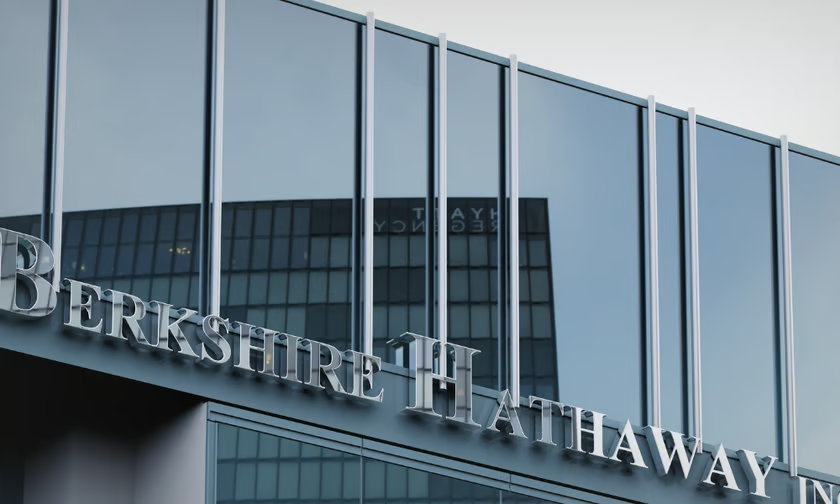
Under Greg Abel’s leadership, Berkshire Hathaway continues to follow the capital allocation strategy that Warren Buffett established over six decades of stewardship.
Berkshire Hathaway has paid just one dividend since Buffett took control of the company in 1965, a single $0.10-per-share cash distribution issued back in 1967.
During Buffett’s 60-year tenure as CEO, Berkshire’s shares gained an average of 19.9% annually, a compounding track record that few investment vehicles in history have matched.
Rather than returning cash to shareholders through dividends, Berkshire has consistently focused on reinvesting its earnings and investment gains into new acquisitions and business opportunities.
Abel assumed the CEO role in January 2026, marking a new era for the conglomerate, but analysts and investors expecting a shift in dividend policy are likely to be disappointed.
In his first letter to Berkshire shareholders, Abel stated, “Our approach to cash dividends continues to be that Berkshire will not pay dividends so long as more than a dollar of market value for shareholders is reasonably likely to be created by each dollar of retained earnings.”
Abel has wasted no time demonstrating that Berkshire remains committed to deploying capital aggressively, with several major moves already completed this year.
On July 24, Berkshire completed its $8.5 billion acquisition of homebuilder Taylor Morrison, signaling continued appetite for large-scale deals under the new leadership.
Berkshire has also increased its equity stake in Alphabet this year, with the company growing its position by $17 billion during Q2, including $10 billion from a private placement in newly issued Alphabet shares.
Beyond acquisitions and equity investments, Berkshire has historically avoided dividends in part because of their tax inefficiency compared to share repurchases, which are only taxable to investors who choose to sell.
Abel has resumed share buybacks since taking the helm, operating under the same policy of only repurchasing shares when management has “conservatively determined” the stock trades below intrinsic value.
Berkshire bought back just $235 million in shares during Q1 2026, but significantly accelerated that pace, repurchasing $4.5 billion in Q2 and an additional $3.5 billion in the period following.
The scale of buybacks suggests Abel is actively balancing new investments with capital returns, rather than letting cash accumulate without purpose on the balance sheet.
That balance sheet remains formidable, with over $350 billion in cash and cash equivalents out of Berkshire’s total $1.26 trillion in assets, giving Abel substantial firepower for future deals.
While Berkshire may never rank among the top dividend-paying stocks, its disciplined approach to capital allocation continues to be the engine driving its long-term investment reputation.