Vodafone Group (VOD.L) delivered one of the starkest corporate reversals of the year, posting a fiscal first-half loss attributable to parent owners of 4.79 billion euros, against a profit of 829 million euros in the same period a year earlier.
Despite the headline loss, the British telecommunications giant moved to reassure investors by lifting its profitability guidance for adjusted EBITDAaL to a range of 13.2 billion to 13.4 billion euros, up from its previous outlook of 13.0 billion to 13.3 billion euros.
Markets were unconvinced by the raised guidance, sending VOD.L shares down 1.37% by the close of Tuesday’s session in London.
While Vodafone weighed on sentiment, luxury watch retailer Watches of Switzerland Group (WOSG.L) offered a contrasting story, with its shares climbing 0.74% after a robust set of first-half results.
The group reported fiscal first-half revenues of GBP974 million, and narrowed its fiscal 2027 revenue growth outlook to a range of 7% to 10% at constant currency, tightening from a previous guidance window of 5% to 10%.
Bank of America analysts were notably upbeat, saying “Watches of Switzerland reported 1H27 revenues of GBP974m, growing +15% cFX, 4 [percentage points] ahead of consensus, marking the 4 consecutive half of double-digit constant-currency growth.”
BofA reiterated its Buy rating on WOSG.L, raising its price objective to 850 pence from 830 pence, and lifted its fiscal 2027 through 2029 earnings-per-share estimates by 3% to 4%.
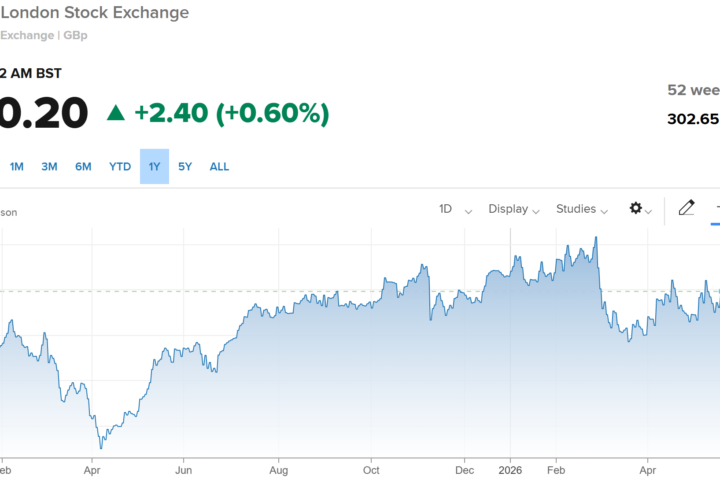
Against this mixed corporate backdrop, London’s FTSE 100 index edged just 0.09% lower on Tuesday, with declining oil prices providing a partial cushion as traders grew more optimistic about a potential resolution to the ongoing US-Iran conflict.
On the economic front, UK retail sales growth came in slightly below expectations in October, rising 1.1% year over year on a like-for-like basis, according to British Retail Consortium data, compared with the 1.2% increase analysts had anticipated, following a 1% gain in September.
The BRC attributed the shortfall to shoppers holding back purchases ahead of Black Friday and the Christmas season, with Chief Executive Helen Dickinson warning that “shoppers and businesses face mounting costs, including rising interest rates and energy bills, adding to the pressures already pushing up prices.”
Dickinson added that “Government must move faster to cut back the taxes and regulations making it harder for retailers to keep prices down,” reflecting broader frustration across the retail sector heading into the crucial holiday trading period.
A separate reading from Barclays showed consumer card spending accelerated to a 2.3% annual rise in October 2026, the strongest pace recorded since July 2025 and ahead of the 2% increase logged the prior month, though all of the bank’s consumer confidence measures deteriorated amid rising household costs and pre-budget uncertainty.